

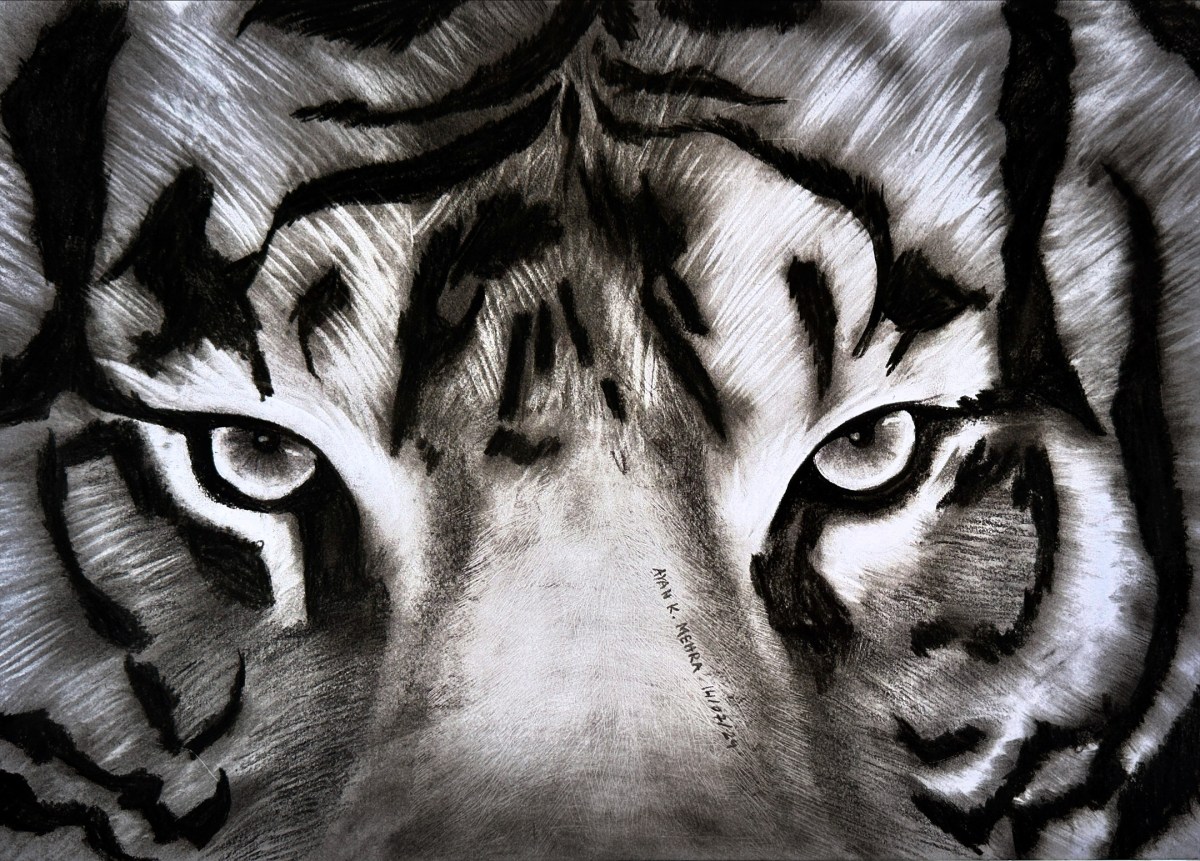
Artwork by Ayan Kamath Mehra
By: Anisa Daniel-Oniko, Nigeria/UAE
The other day, my family and I were playing a game called Name-Place-Animal-Thing, which works quite simply. You work through the alphabet, naming one of the aforementioned for each letter you land on. Somewhere around the T, we turned reflective.
“You know,” my mother said. “If we don’t work very hard, children will be born that will never connect the letter T to the tiger.” It is a sad reality. So many species have already been spun into myths and memories, and if we don’t devote ourselves to eradicating the cycle, it will continue. But just how does that cycle begin?
Well, it is common knowledge that certain animals are poached for body parts and products (such as ivory, or shark fin soup). However, even if you don’t count illegal trade, hunting and harvesting have decimated the numbers of several species, blotting out some entirely (National Research Council (US), 1995). This, for example, was the fate of the passenger pigeon—a bird that abounded in American airspace during the 1800s. The ease of hunting the birds dwindled their numbers to nothing—the very last one, Martha, died in captivity in 1914 (National Museum of Natural History, 2019).
Then there is the matter of habitat. Climate change aside, anytime humans expand territory, the ecosystem suffers dire losses. Animals who previously inhabited the lands and seas—such as the dodo, or the Okinawa dugong (Koja, 2024)—are felled by civilization, new cohabitants, or disease. Humans and other species don’t live well together—we hunt or hinder each other often, stealing livelihoods. Like fitting a square peg into a round hole, urbanisation and urban sprawl cannot be done without destruction.
That is how extinction happens, and already the tigers have joined the ranks of the 45,300 IUCN-indexed species threatened by it (IUCN, 2024). Three tiger species are already extinct, and double that are currently endangered (McGonagle, 2024). But the conservation battle isn’t one without hope. In Bhutan this year, after a yearlong research expedition,131 Bengal tigers were discovered, 27% more than in 2015 (United Nations Environmental Programme, 2024). This spike was brought on by the tireless efforts of conservationists in the region and proves to us something vital. It is possible to turn back the tide on the damage done to the environment, and perhaps children will still grow up remembering that T is for the big cat with stripes.
References
IUCN. (2023). The IUCN Red List of Threatened Species. IUCN Red List of Threatened Species; IUCN. https://www.iucnredlist.org
Koja, K. (2024, June 3). No dugongs found near Marine base on Okinawa after 3-year search, officials say. Stars and Stripes. https://www.stripes.com/branches/marine_corps/2024-06-03/dugong-marine-corps-runway-okinawa-14064158.html
McGonagle, J. (2023, November 28). Tiger Subspecies: Six Surviving- Three Extinct. The Tiniest Tiger. https://conservationcubclub.com/tiger-subspecies-six-surviving-three-extinct/
National Museum of Natural History. (2019). Extinction Over Time | Smithsonian National Museum of Natural History. Smithsonian. https://naturalhistory.si.edu/education/teaching-resources/paleontology/extinction-over-time
National Research Council (US). (2016). Species Extinctions. Nih.gov; National Academies Press (US). https://www.ncbi.nlm.nih.gov/books/NBK232371/
United Nations Environment Programme. (2024, January 19). In Bhutan, the endangered Bengal tiger is making a comeback. UNEP. https://www.unep.org/news-and-stories/story/bhutan-endangered-bengal-tiger-making-comeback
 Harmony Online Journal - Youth Voices on Science, Law and Sustainability