Nature-Based Flood Management in Our East Anglia Fens and Water Systems: Intergenerational Insights

Our misty green fenlands of East Anglia are drying up and sinking, as loss and damage due to climate change, nature destruction and flooding is increasing. A century and a half of drainage and questionable water management has left much of Cambridgeshire below sea level, held up only by pumps and ageing banks — and that same drainage is destroying the very peat this rare natural ecosystem, and the people who live in it, depend on.

Our Fenlands Restoration for Flood Defences project, part of GYC-SLS Cllr Nico Cordonier Gehring’s UWC Atlantic Systems Transformation Pathway intervention, is exploring how nature-based solutions like re-wetted fenlands can work alongside other flood defences. We are advocating for green not just grey infrastructure, so that our precious local wetlands and waterways can foster rather than frustrate sustainable water systems governance (SDG 6), promote climate change mitigation, adaptation and resilience (SDG 13) and protect critical habitat for biodiverse species (SDG 15).

Over the past months we have consulted scientists, community groups and drainage boards, created new educational materials and a homepage, run workshops in local rural and urban schools to pilot the materials, edited a Heron Habitat Helpers Handbook for local children and families and a special SDG 6 clean water issue of our Harmony youth online journal, and spoken up for future generations in local and global water and wetlands events. We also advocated for the rights of the River Cam, in a special community festival on 21 June 2026, and celebrated the Cambridge City Council’s recent historic resolution to recognise the river’s rights.
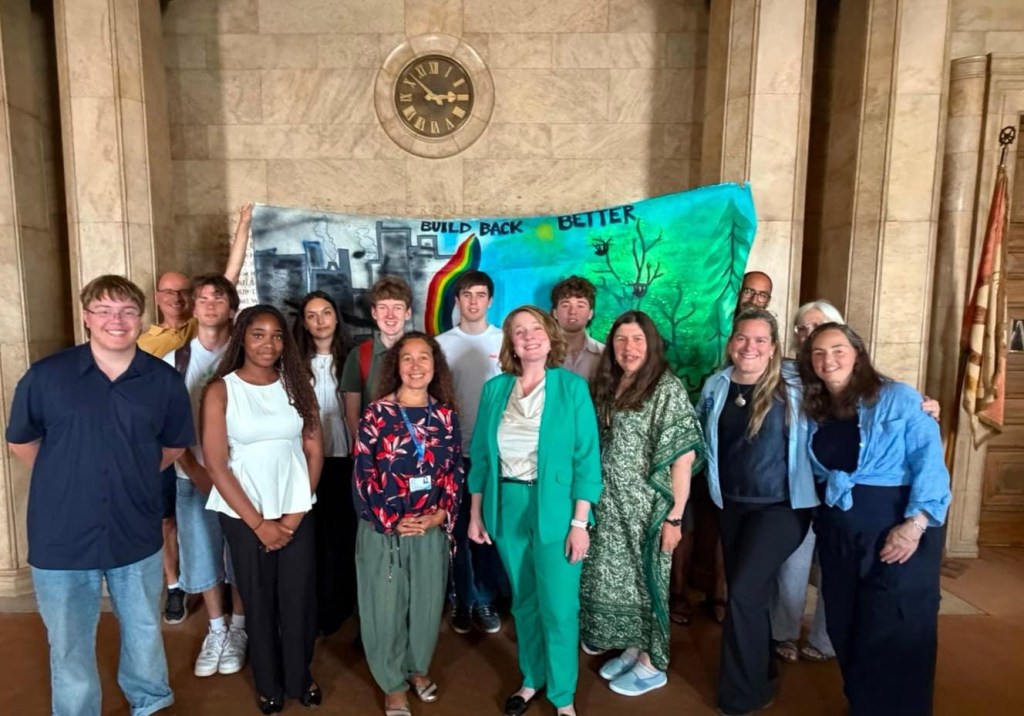
Participants standing together in the Guildhall foyer in front of a hand-painted banner reading Build Back Better
Participants at the Intergenerational Roundtable, Cambridge City Council Guildhall, 22 July 2026.

Making the invisible visible

Teaching the fens is harder than it sounds, because the fens do not look like a crisis. They look like flat, productive farmland. As Nico explains, that is precisely the problem — the peat is subsiding by centimetres a year, invisibly, and the flood defence conversation is still framed as a choice between concrete and doing nothing. So our workshop decks for Years 5–8 and Years 9–13 have been rebuilt to make the invisible visible: feedback loops, the iceberg model, and a sponge experiment that lets a nine-year-old feel the difference between saturated peat and drained peat in their hands. The Heron Habitat Helpers Handbook takes the next step, converting understanding into something a child can actually do — a pond to build, herons to tally, compost to buy peat-free. All of it is being prepared for a dedicated GYC homepage, so that any teacher in the region can pick it up and run it without us in the room.
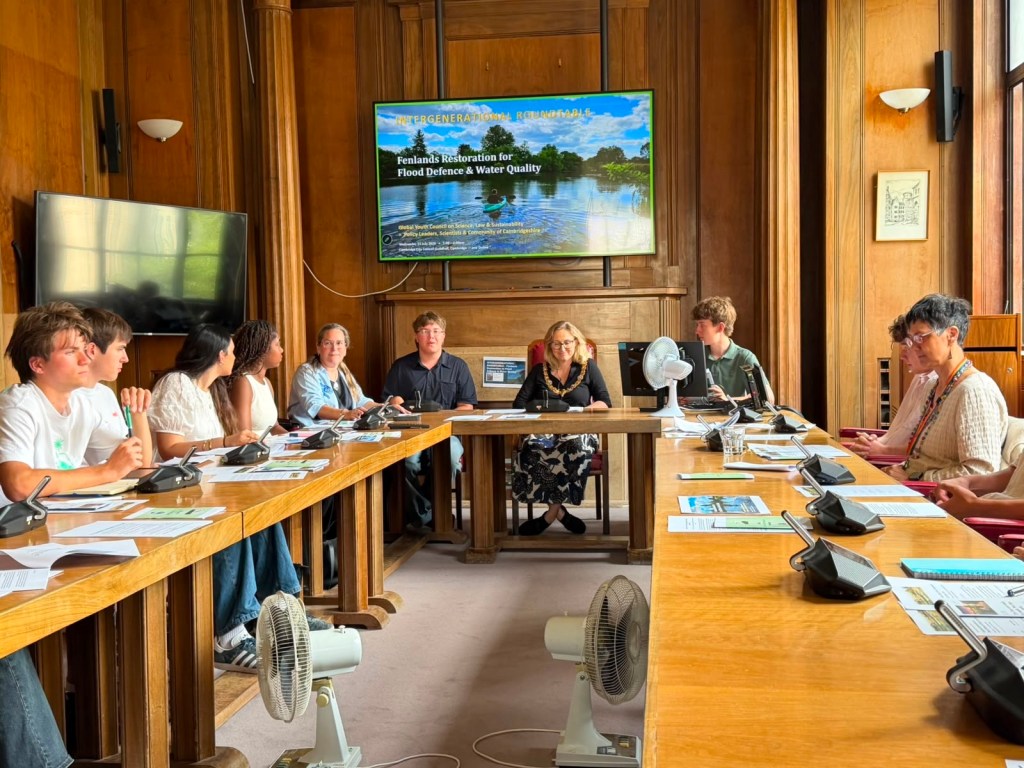
Young people and councillors seated around the wood-panelled council chamber table with microphones, beneath a screen reading Intergenerational Roundtable: Fenlands Restoration for Flood Defence and Water Quality
The Intergenerational Roundtable in session at the Cambridge City Council Guildhall.

Young people have been sharpening these materials rather than simply receiving them, and their critique has been sharper than our own. As Jeremi highlights, materials that explain the problem without offering agency risk leaving children anxious rather than equipped — the emergency framing has to arrive alongside something to do about it. As Katie and Graeme note, the fenlands natural land and waterscapes are priceless, but urban-rural splits may matter: a pupil in a Cambridge classroom, a pupil in a flooded Peterborough development, and a pupil in a village where the family farm pays a drainage board levy come to wetlands with entirely different starting assumptions, and one set of slides cannot serve all without acknowledging that. As County Cllr Ros Hathorn observes, there is something genuinely heartening in seeing young people from right across the county — cities, market towns and villages alike — choosing to work together on this, and in the clarity of their commitment to protecting nature and the local ecosystems they have grown up in.
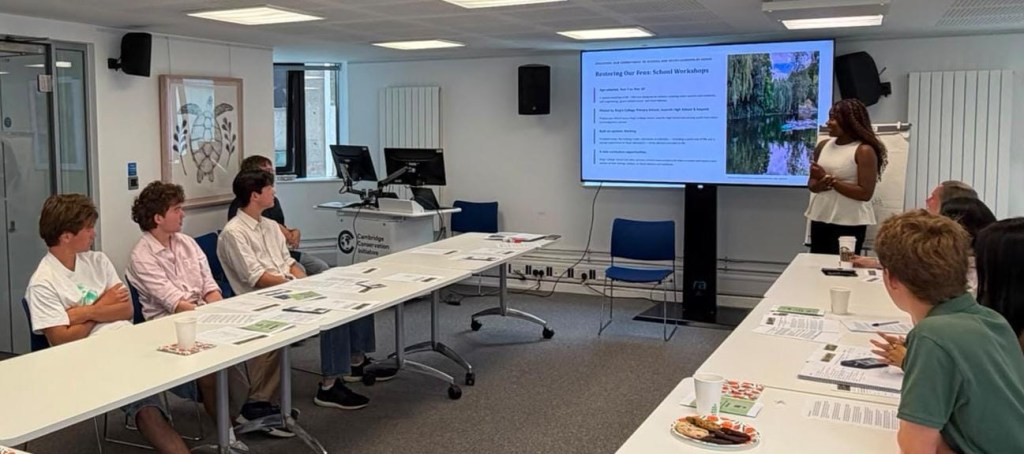
A young person presenting a slide titled Restoring Our Fens: School Workshops to participants seated around tables at the working session
Presenting the schools workshop programme for review at the Youth Working Session.

That commitment needs somewhere to go, though. As Sophia proposes, with Nico, Jeremi, Ethan, Saskia, Thomas, Joseph, Katie, Carla and Ras among others fully supporting, what the fens now need is a standing Fenlands Youth Advisory Commission, so that young people are built into the consultation and planning processes as a matter of course, rather than invited to speak once and thanked. Alongside the teaching materials, we are building the case outwards — pursuing Ramsar Wetlands City accreditation for Cambridge and Peterborough, a status no city in the East of England yet holds, and editing a special SDG 6 clean water issue of our Harmony youth journal that tells the story of the fens to young readers well beyond them.

What it will actually take to shift the system

Our declaration makes a specific claim: that flood and water management is a system, not a single line of defence, and that wetlands and floodplains are green infrastructure — not a soft alternative to real defence, but a working part of it. Every hectare of reconnected floodplain is a hectare of burden lifted from engineered assets that cannot easily be replaced. Our petition turns that into five asks of the Internal Drainage Board, water authorities and the Fens 2100+ programme: restore and create wetlands, adopt soft engineering alongside hard infrastructure, recognise wetland habitats as part of the flood defence system, reduce long-term pressure on ageing assets, and listen to the community. As underscored by the Mayor of Cambridge, Hon Maria Cleminson, none of this is a demand to dismantle the infrastructure that keeps homes and farms viable — it is a demand that the infrastructure stop being asked to carry the load alone. As Prof Marie-Claire Cordonier Segger emphasises, Ramsar Wetlands City accreditation would give that argument real institutional weight: an internationally recognised standard, held by no city in the East of England, that binds urban planning to the health of the wetlands surrounding it and makes the commitment far harder to quietly drop.
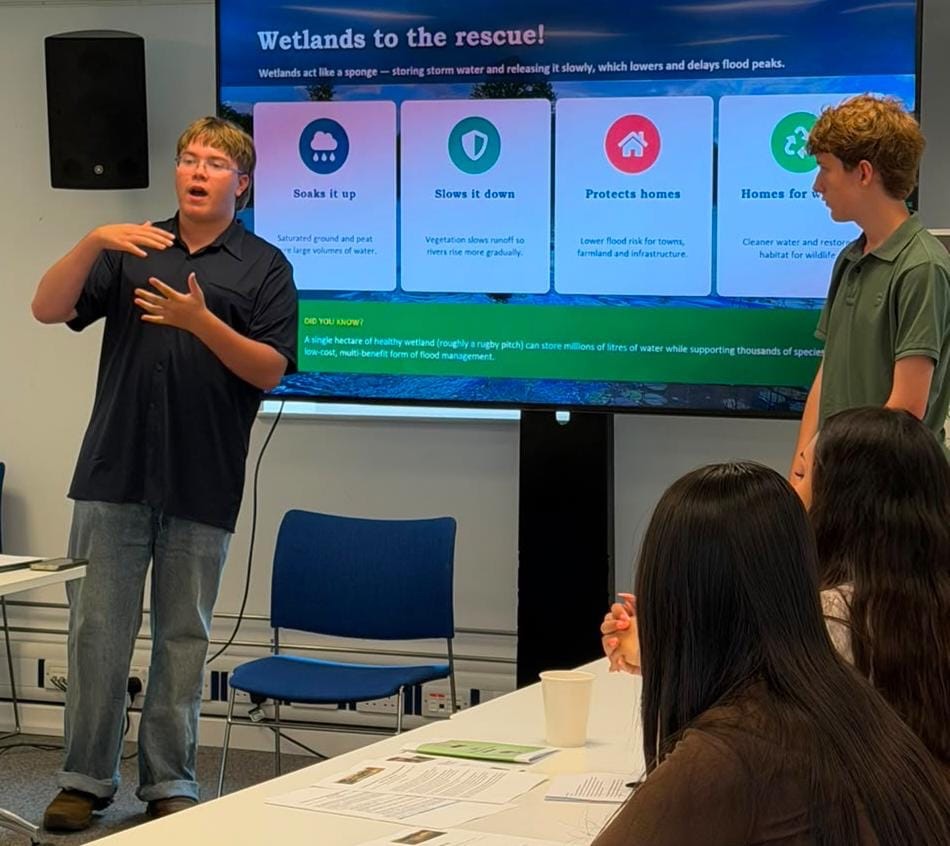
A young person explaining a slide headed Wetlands to the rescue, showing how wetlands soak up and slow floodwater, protect homes and provide habitat
Explaining how re-wetted fenland stores and slows floodwater.

The harder question is not whether wetlands work, but why that knowledge is not moving resources including financing. Where are the political and legal openings for fen restoration to be treated as flood infrastructure rather than conservation? What would it take for wetland restoration to compete with concrete when funding decisions are made? Farming, water quality, development and flood risk pull in different directions — who resolves that, and at what level? What is the single biggest regulatory obstacle to large-scale rewetting, and could the River Cam’s newly recognised rights be made to do real work?

As Cllr Dr Antoinette Nestor observes, the constraints here are practical rather than ideological: appraisal rules, land tenure, and the question of who holds the pen. As Cllr Katie Thornburrow stresses, that is exactly why these voices have to be heard at every level at once — city, county, drainage board and national programme — because a case made convincingly in one forum can still fall silently at the next. That is a more tractable problem than disagreement — and a reason to keep pressing. Cllr Cheney Payne and Cllr Olaf Hauk underline the importance of this work, and Cllr Naomi Bennett calls for urgency as the crisis worsens. Our declaration has been strengthened accordingly, and now closes with a commitment we made to ourselves as much as to anyone else: that as the young people of today, we recognise the impact we and future generations will have on water supply, use and quality, and we undertake to mitigate the impact we as humans have on water as part of the ecosystem. The petition is now going out as widely as we can carry it. The Mayor of Cambridge Hon Maria Cleminson and Cllr Dr Antoinette Nestor have already signed.

Our warmest thanks to everyone who took part in the Youth Working Session: Reviewing Our Educational Materials, Declaration & Petition, held at the David Attenborough Building on Wednesday 22 July 2026 — and in particular to the young people who travelled in from across Cambridgeshire, including Peterborough, Cambridge and the surrounding villages, whose scrutiny made the materials better. Our thanks also to everyone who contributed to the Intergenerational Roundtable at the City Council Guildhall that afternoon — the councillors, experts and scientists, community leaders, and above all the young people, whose voices were most definitely heard.
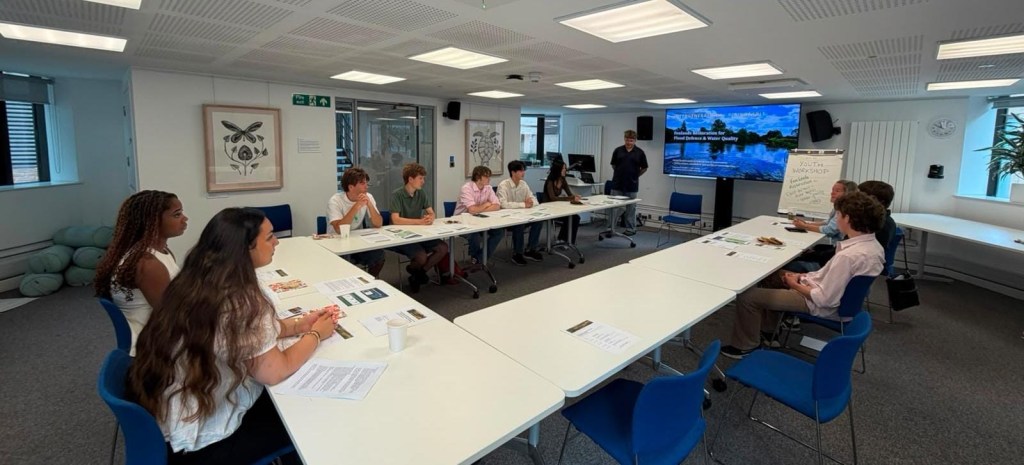
Participants seated around a large open square of tables in a meeting room, with a presentation screen reading Fenlands Restoration for Flood Defence and Water Quality and a flip chart headed Youth Workshop
The Youth Working Session at the David Attenborough Building, 22 July 2026.

Add your name, and share the opportunity to be a voice for future generations with others.

Climate Change

By Anisa Daniel-Oniko

Climate change.

Two words as heavy as the weight of the world balanced precariously on the shoulders of Atlas.

Human beings, though Titans we are not, have to balance the health of our world on our fragile shoulders. Tough though it may be.

So in the case of Climate Change, we are Atlas.

But unlike Atlas, we can find and create solutions to lighten our burden ourselves.

One such solution to the pressing issue of climate change is simple.

Another pair of weighty words.

Energy conservation.

Take a moment to think about the energy use in your home. How often do you switch off the lights after you leave a room? After you leave the house? Do you leave your water running constantly as you brush your teeth? How about electricity? Do you use an air conditioner at full blast even when the weather is agreeable enough to lower the scope of its icy powers a bit?

You see, when you think about it, there are a lot of tiny things that contribute to our carbon footprint, and our impact on our world, (And yes, our utility bills).

My mother often says that charity begins at home, and the same is true of actions towards climate change.

Start at home.

The thing about climate action is that each one of our steps matters in the massive carbon footprint of the human race. When we start taking small steps to be eco-friendly at home, it gives more room for bigger events and discussions, such as making the switch to greener energy sources as opposed to fossil fuels.

Perhaps you’ll be okay if you switch off your bedroom lights this once. I know that you will be. You can do it the next time too! You’d also do just fine to swap out those light bulbs with energy-efficient ones while you’re at it. Go on! Nature is proud of you! And I am too.

Contributions of Physics to Global Response to Climate Change


By Jona Cordonier Gehring

Many areas of science are integral to resolving our current climate crisis, and science will be even more crucial in the future. Engineers are starting to help us design more efficient and less polluting transport, biologists and agronomists will have to help us refine our agricultural systems, silviculturalists will help us protect and restore the forests, and chemists will have the important role of creating the technologies that will allow us to the manufacture goods we need while keeping to our carbon commitments. However, physicists are often left out of the equation. 


But the contributions of this area of science to helping us respond to climate change are immense and growing. First of all, many of the technologies we now use to combat climate change and reduce greenhouse gas emissions were made in physics labs. For example, the interactions between semiconductors that allow solar panels to function. Nuclear energy is another advancement in physics that may help us to change the energy resources we rely on, and while even fourth generation nuclear power isn’t a good solution until it can be made safely without hazardous waste, it is significantly better for our climate then the fossil fuel alternatives. 


However, the most important contributions of physics to addressing the global challenge of climate change isn’t one of these ideas. Rather, it is the fundamental, groundbreaking physics research that has allowed us to begin to understand the scale and scope of the problem itself, and the modelling that has allowed us to predict future climate change scenarios and to begin to uncover how we can prevent our own actions from rendering our future unsurvivable. 
Just this year the Nobel Prize in physics half was awarded to two scientists, Syukuro Manabe and Klaus Hasselmann, ‘for the physical modelling of Earth’s climate, quantifying variability and reliably predicting global warming.’ It is this modelling that has allowed us to have a much clearer understanding on the challenges we face. The Intergovernmental Panel on Climate Change (IPCC), one of the most influential scientific institutions in the 21st century is focused on climate change and largely consists of physicists. But modelling is not the only major contribution that physics will make to solving the issue of climate change.

Nuclear fusion (or fusion power as it is generally known) is a technology that is theorized to produce energy by super heating usually isotopes of hydrogen, deuterium, and tritium (with 1 and 2 neutrons respectively), until they are in a hot enough plasma in order to have their nuclei fuse, releasing helium and producing electricity. The potential is fantastic. One glass of water (the main source of hydrogen through electrolysis) would produce the same amount of energy as burning an entire barrel of oil. Also, there are no harmful levels of radiation. Unfortunately, the technology is still under development as producing conditions similar to the core of the sun, on earth, for a long enough time frame to make it economically viable as a power source, remains a tricky challenge. Progress is being achieved faster then ever, with ground-breaking developments happening internationally, with many large companies and private investors providing funds for development. We could see nuclear fusion to be viable by the end of the decade.This will be too late to contribute significantly to the short-term mitigation plans. However, it will be a massive boon to the long-term solutions and the general future of the energy production.

In short, physics has had an immense impact on climate science, and it will continue to have an ever-increasing roll in this area and in our entire future.

Healthy Fenlands fight climate change


By Thomas Langford

Cambridge, where I live, is a small city amid the East Anglian wetlands in the U.K, known to us as fenlands.

Fenlands are one of the most carbon dense environments on the planet, which, if protected, reduce flooding, support diverse life systems and capture and lock in CO2 from the atmosphere through photosynthesis.

The wet conditions of fenlands stop the plants from fully rotting, trapping CO2 which otherwise would be released into space. Peatlands in general store approximately 3.2 billion tonnes of carbon in the UK. Left undisturbed, they are a carbon sink but farmed they are an immense carbon and methane source.

Research shows that fenlands do not always act as carbon sinks: the fenlands themselves must be maintained as “healthy” fenlands. The National Trust’s Wicken Fen , for example, a local protected fenland, demonstrates within it both a carbon sink and source: one fen, Sedge Fen, is uncultivated and is a carbon sink whereas another, Baker’s Fen, has been farmed disturbing the carbon, releasing CO2 into the atmosphere and making it a carbon source .

To keep unprotected fenlands healthy, they need to be: kept wet (to prevent erosion which releases carbon into the air), to be planted appropriately with, for example, reed and sedge; and for wildlife areas to be created to encourage and protect the ecosystems. It is greatly important to ensure that the water flow in fenlands is free from obstruction. Reducing litter and re-planting the fens are areas with which the community and local councils can help once awareness of the problem has been raised.

There are community organisations which are currently working to promote restoration projects across our county and beyond, such as the UK Centre for Ecology and Hydrology

The UKCEH is working with the government to monitor CO2 emissions over a 2 -year period resulting from different levels of water within the fenlands. Their work so far indicates that when the water levels are raised, it improves the quality of the soil and cuts back CO2 emissions.

The UK government has compiled a strategic wetland action plan to support the UK’s climate change programme and the EU’s L.I.F.E funding has assisted many wetland restoration projects. Such projects are a cheaper alternative to other methods being used to reduce greenhouse gases and, what is more, have the happy benefit of increasing biodiversity and enhancing the precious wetland ecosystems.

Government action is not enough though: they should be organising more ways to stop climate change, to raise awareness and to financially encourage people to change their habits to support the fenlands. Litter pick-ups are free, for example, but have a big impact on our planet.

Farming practices in fenlands are crucially important in keeping fenlands as carbon sinks. Across East Anglia, soil in the fenlands, when drained, is extremely rich and fertile and so has been heavily farmed for food production – our fen farms produce one third of the fresh vegetables farmed in the UK! .

Traditional farming practices require machines to cut into the land, churning up the earth, destroying the delicate ecosystem of worms and roots and, importantly, releasing CO2 stored within the carbon-rich fenland into the atmosphere.

Some local farmers that I interviewed are instead using the method of cover crops and direct drilling. This entails planting shallow rooted seeds such as clover and winter peas which take nitrogen from the air into the soil and block weeds, then planting the main crops directly into the covered field without ploughing or cultivating the land.

This reduces the need to pass over the field multiple times which would otherwise use a lot of diesel: farmers using this method are reporting a reduction of at least 50% in their diesel usage.

With this method, soil structure is maintained as it is only disturbed at a shallow level, allowing the worms and plant roots to thrive and create healthy soil as well as keeping carbon locked in.

The cover crops reduce the need for chemical fertilisers and provide food for grazing animals such as sheep (who, in turn, provide manure to further fertilise the land).

The farming community need more assistance and incentives for farmers choosing organic and conservation farming methods. Members of the public need to be made more aware so that consumers can choose to buy food from more climate smart, local food providers.

Fenlands are a crucial weapon in this climate war. Our planet has provided the means to heal itself if we take steps to protect them. Please help to spread awareness that fenlands are not just a wonderful place to spend time in but that they are also working hard to undo the damage we are doing to our planet. Small steps taken by individuals can make as much difference as big steps taken by governments.

The Importance of the Conservation of Peat Landscapes


By Taanvir Sood

Peat, also known as turf, is an accumulation of partially decayed vegetation or organic matter. In peat landscapes, year-round waterlogged conditions slow the process of plant decomposition to such an extent that dead plants accumulate to form peat. Large amounts of carbon fixed from the environment into plant tissues though photosynthesis is locked away in peat soils. The peatland ecosystem covers 3.7 million square kilometres (1.4 million square miles) and is the most efficient carbon sink on the planet since peatland plants capturing carbon dioxide naturally released from the peat, maintaining a net equilibrium. Peatlands store up to 550 Gigatons of carbon, 42% of all soil carbon despite covering just 3% of the Earth’s land area.

However, peatlands are slowly disappearing. Peatlands are being destroyed because it is being extracted unsustainably from landscapes. Peat is used excessively as fertiliser to nourish plants and is possible to buy large bags of it at retail warehouse stores unchecked and in an unrestricted manner. Peat landscapes are also destroyed to make space for grazing areas for sheep and cows. These already polluting animals increase their carbon emissions further as acres of peatland are destroyed to grow grass for grazing pastures. It is also used to purify water as it removes 99.9% of petroleum and heavy metals from contaminated water. This is due to its hydrophobic properties, allowing to absorb twice as much petroleum per pound than activated carbon. Peat is also known as the forgotten fossil fuel. It is often used for domestic heating purposes, household cooking and even used to produce electricity as an alternative to firewood. However, it is the most damaging fuel in terms of global warming. It has a lower calorific value (meaning it produces less heat) and yet it produces higher carbon dioxide emissions per unit. It is the least climate efficient way to produce electricity, yet it was used extensively in countries such as Ireland. Dried peatlands are also prone to forest fires such as the fire in Indonesia in 2015. This destroyed large areas of animal habitats and generated over 600 million tons of carbon dioxide. These wildfires also contribute significantly to carbon emissions.

Luckily, degraded peatlands can be restored to prevent the further breakdown of stored plant materials. The primary method of restoration involves re-wetting or restoring the natural flow of water and soil saturation. The main challenge however is economic since altering drainage patterns and local hydrogeography can be costly. The technology needed already exists but only 18% of the total mitigation potential for peatland restoration can be implemented at a low cost. Peatland restoration also takes a long time as peat takes at least 100 years to form. However, peatland restoration would prevent the release of 394 million tons of carbon dioxide per year, equivalent to the 84 million passenger vehicles per year. The restoration of peatland would go a long way in solving the climate change and global warming crisis we are facing and action to save it must be taken now.