
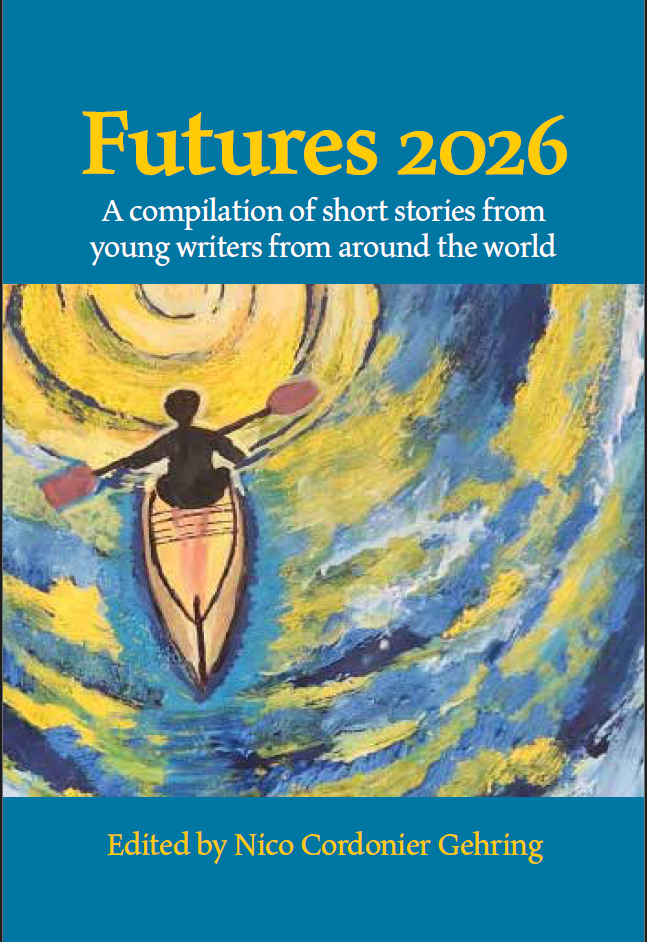
In a world where climate change and sustainability concerns define the challenges of our time, the youth are no longer asking for permission to speak. They are writing their own futures. Futures 2026, published by the Voices of Future Generations Children’s Initiative, brings together thirty award-winning short stories from young writers spanning six continents, offering a compelling vision of sustainable futures through the eyes of the next generation. Alongside this collection, young people ages 8–18 from around the world submitted short articles, photos, and artwork.
Published annually, Futures is now in its second edition. The breadth of this year’s stories is striking: the thirty pieces touch on clean water and sanitation, affordable energy, climate action, life below water and on land, gender equality, quality education, reduced inequalities, sustainable cities, and peace and justice. What gives the collection its force is the way these global challenges appear not as policy abstractions but as lived realities experienced by young protagonists in India, Myanmar, Canada, the UAE, Argentina, Nigeria, Romania, and beyond.
Stories That Show the Way
Environmental Stewardship
The dominant thread running through Futures 2026 is environmental stewardship. Most stories centre on a specific threatened landscape and on the young protagonist who fights to protect it. In “Zayar and the Thirsty Machine” by Myat Pan Khit (Myanmar), seventeen-year-old Zayar lives in a 2050 Yangon where fresh water arrives three times a week and the Ayeyarwady River has dried up—drained by the cooling demands of AI data centres. After discovering what the river once was, Zayar and his friends salvage parts from a tech graveyard to build a solar-assisted condensation unit that pulls moisture from the air and returns it to the earth.
In “The Last Monsoon Dancer” by Saanvi Rao (UAE), fourteen-year-old Sriya performs a traditional dance not to summon rain but to confront her community with what they have done to the land, pouring a single cup of clean water onto cracked earth and whispering, “To the last drop, because we waited too long.” Her protest goes viral, sparking conversations about water, climate, and courage.
In “The Last Mango Tree” by Aditi Haribabu (UAE), fifteen-year-old Tara wages a campaign to save the last mango tree in her rapidly industrialising village. Her “Roots of Tomorrow Campaign” gathers stories of environmental loss from across India and the UAE. A year later, her village passes a “Heritage Green Zones” law and the tree is declared a protected eco site.
In “The Last Mangrove Guardian” by Aleena Sara Jesson (UAE), fourteen-year-old Maha exposes toxic sludge poisoning her village’s mangrove forest using drone footage and water samples, launching the #GuardOurGreenLungs campaign that reaches national media and prompts a government task force.
In “Guardian of Sea” by Ananya Manikandan (UAE), twelve-year-old Carlos rescues a penguin chick from an oil spill on a Patagonian beach and founds Los Guardianes del Mar, a cross-border marine conservation network. In every case, environmental action grows from love for a particular place rather than abstract principle.
Indigenous Identity and Cultural Survival
A powerful cluster of stories, predominantly by Canadian authors, explores Indigenous identity and cultural survival. In “The New Moon” by Lissie Usuituayuk (Canada), Inuit teenager Tayen navigates displacement from Salluit to Montreal and finds belonging through an Indigenous youth programme and a community garden that links cultural survival to environmental care.
In “Discovering My Roots” by Maddy Mcardle (Canada), an adopted Cayuga girl reconnects with her nation through ceremony, beading, and an elder’s patient teaching—a story that confronts the legacy of the Sixties Scoop. These stories treat cultural identity as something that must be actively recovered, with a mature awareness of the historical forces that created the disconnection.
Technology and Its Costs
Several stories grapple with technology and its costs. “Between the Circuit and the Soul” by Virat Desai (UAE) frames the dilemma as an essay: the narrator is fascinated by technology and afraid of it in equal measure. “The Girl Who Grew a Forest” by Naomi Kene (Canada), set in the year 3002, follows a teenager who steals an extinct seed and descends to Earth to plant it among people who have chosen soil over simulation. In every case, the antidote is a return to something physical.
Gender and Justice
Gender and justice surface throughout the collection. In “The Last Monsoon Dancer,” Sriya defies a culture that silences girls to perform a protest dance that goes viral, forcing her village to confront what it has done to the land. In “Where Justice Wears Heels” by Afroz Idariya (India), Ann takes her school’s systematic discrimination against girls to court and wins. The protagonists who save the tree, the mangrove, and the river are overwhelmingly girls dismissed before they were heard.
Small Beginnings and Intergenerational Wisdom
Binding everything together is a conviction about small beginnings and intergenerational wisdom. The young protagonists draw on grandmothers, elders, and inherited stories even as they act in urgently modern ways: launching social media campaigns, building condensation units from salvaged tech, founding floating libraries. The book does not promise that everything will be fine. It promises that the attempt matters, and that one refusal to stay silent can multiply into something larger.
Why Futures 2026 Matters
As UN Special Rapporteur Prof. Astrid Puentes Riañó writes in the anthology’s preface, these young authors “do what law and policy sometimes struggle to do: they make visible the human meaning of environmental harm and environmental protection.” The stories “speak of loss and resilience, of injustice and care, of fear and courage.”
Judge Prof. Marcel Szabó emphasizes that the anthology proves “even the smallest voices, when raised with courage, can shift the tide of governance and accountability.” Each child’s perspective adds an essential piece to the global conversation.
Join the Movement
The young authors of Futures 2026 show that storytelling is both a creative expression and a tool for change. As one story brilliantly summarizes: “Cool people don’t deserve a warm planet.”
Through stories, artwork, articles and photos, young people are helping shape the global conversation on sustainability. Now it is your turn. Your words, images and ideas can spark change and influence discussions at the highest levels of global climate policy. The future is being written now. Make sure your voice is part of it.
Read and share Futures 2026, and consider ordering copies for friends, schools and libraries. In doing so, you will help celebrate these young voices and encourage even more young people to write, create and speak up.
For more information, visit VoFG and GYC. Download the free PDF here, order a copy here, and revisit last year’s edition here. The call for Futures 2027 is expected in May, stay tuned!
 Harmony Online Journal - Youth Voices on Science, Law and Sustainability