By: Carlos Andrés Olivera Caballero, Bolivia
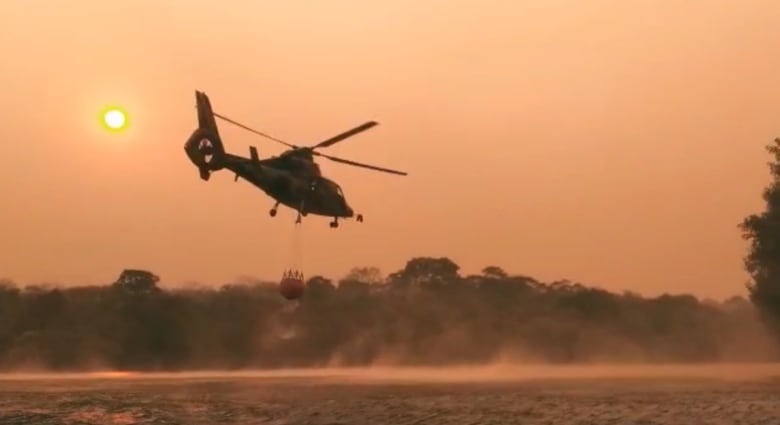
Sitting here at my desk, the sun is nowhere to be seen. This should be a bright, clear morning in Santa Cruz, America’s purest sky, but thanks to these thick, omnipresent, smoke clouds, the morning’s been transformed into an apocalyptic scene. The smoke-filled air is so thick that from my window the orange haze blots out the sun. The fires now ravaging our forests are of such intensity that the flames are no longer on the horizon; they are in our lungs, our eyes, and our future. We are fighting to breathe. I can feel the smoke in my chest, and it serves as a daily reminder of the urgency of the situation we face. This is not a problem lying at a distance for someone else to solve. It is here, choking my community, our land, and our hope. This year’s fire season is ravaging Bolivia as never before.
This year alone, more than 2.9 million hectares were consumed by the flames (United Nations Office for the Coordination of Humanitarian Affairs, 2024). In Santa Cruz and Beni, two of the most affected regions, it is destruction beyond your imagination; it’s a perfect storm created by deforestation, expansion of agriculture, and fire-prone ways of cleaning the lands. According to reports from the “Fundación Tierra,” (2024), more than 4 million hectares have been consumed by fire this year, a figure that is still growing day by day. The scale of the disaster makes it more than a natural disaster; it is a failure of governance-a reflection of a broken system where either the competencies or the resources, or both, are ineffectively distributed between different levels of government.
The Problem: Misaligned Resources and Responsibilities
I believe the main cause underlying this environmental disaster is a structural imbalance in the Bolivian political system. Municipalities, which are the closest to the sites of disaster and in the best position to respond against such disasters, remain underpowered in terms of legal competence to act. The current constitution allocates a considerable magnitude of higher financial resources to municipalities; however, it does so without giving them competencies to legislate on environmental protection and land management. On the other hand, departmental and national-level governments, which have large-scale competencies to address (Fundación Tierra, 2024) fire and deforestation, are grossly underfunded. The subsequent dislocated investment in such ventures has left Bolivia underprepared to contain the fires and avoid further disasters.
The irony is that municipalities, which would, therefore, be able to react faster and more efficiently at these fires, are hamstrung by legal constraints. They have the financial capacity to invest in fire management and fire prevention but lack the legal framework to legislate on these matters. Meanwhile, the departments and national government, while having the authority, are financially starved and unable to deploy resources effectively.
The Consequences of Inaction
This can be seen in all regions of Bolivia where mechanised agriculture has led to about 30% deforestation, more specifically due to the production of soy. In the last 15 years, over 1 million hectares of forests have been destroyed at a rate of 60,000 hectares per year. The eastern part of Santa Cruz includes provinces like Ñuflo de Chávez, Chiquitos, and Guarayos, where 99% of its soy plantations have overlapped with areas of devastating forest loss (ANAPO, 2021).
While only Santa Cruz has lost 1.38 million hectares due to fires between 2001 and 2023, recent weeks in Ñuflo de Chávez reported 3,255 fire alerts, while the region of Chiquitos saw 1.37 million hectares lost to flames (Fundación Tierra, 2024). These are not abstract numbers; this means the whole ecosystem has been annihilated, hundreds of species of animals brought closer to extinction, and native people displaced. The fire crisis has worsened to the point where Bolivia is struggling to meet its commitments under the protection and restoration of life on land called for by SDG 15.
The Urgency for Constitutional Reform
In the face of this worsening crisis, we urgently need to recast our political system. We clearly have one that isn’t working, and unless we change course, these fires will only continue to worsen. I hereby propose a constitutional reform that will make environmental management a competence shared by the municipalities and the departmental governments. In relation to this issue, it should be at the discretion of the municipalities, which are closer to the problem and also possess better conditions to do so. To this end, it should be in their powers to create local fire management teams, intervene faster when the first fires appear, and have the ability to legislate on fire prevention and environmental protection.
The reformed system would only have the national government provide support in special cases, when additional resources might be required. Not only would this distribution of powers handle Bolivia’s response to fires more smoothly but also create a system of land management that is indeed sustainable. Municipalities can utilise their resources to form local brigades empowered to handle fires as soon as they arise and limit the scale of damage with early intervention.
A Future Worth Fighting For
Of course, it is in moments like these that a person just feels powerless, sitting and watching the smoke rise and the sunlight fade. Relentless is how such fires appear to be, and the damage they cause feels irreversible. But looking ahead, we really can’t afford to simply sit with our arms crossed, waiting for help to come. It was about time we demanded this system to work! We need a political structure that allows for swift, effective action when the forests-and therefore, our future-are on fire.
We owe this to ourselves, our children, and our planet. This may be one of the worst fire seasons Bolivia has ever seen, but with proper reforms in place, it might be the last. A constitution that truly empowers local governments to act swiftly and unwaveringly could spell the difference between a Bolivia consumed by flames or a Bolivia that rises from the ashes, stronger and more resilient.
While the sun tries to break through thick smoke outside my window, that gives me hope. The fire may be at a rampage, but it is not burning out our will to fight for a better future.
References
ANAPO. (2021). Agricultural expansion and deforestation in Bolivia. Santa Cruz Report.
Fundación Tierra. (2024). Fires and land degradation: Bolivia’s environmental challenge. Annual Environmental Report.
Global Forest Report. (2023). Deforestation and forest fires in Bolivia. Global Forest Watch.
UN. (2023). Sustainable Development Goals: Life on Land (SDG 15). United Nations Environment Programme.
United Nations Office for the Coordination of Humanitarian Affairs. (2024, September 6). Latin America and the Caribbean: Weekly Situation Update (as of 6 September 2024). Unocha.org. https://www.unocha.org/publications/report/colombia/latin-america-and-caribbean-weekly-situation-update-6-september-2024
 Harmony Online Journal - Youth Voices on Science, Law and Sustainability