By Aditi Haribabu, UAE
There once was a twelve-year-old girl named Anaya who lived in Al Noor, a desert city where the buildings were extremely sophisticated and sustainable. The city was made up of skyscrapers which had solar panels and vertical gardens. Autonomous buses drove silently along the streets while drones delivered packages.
To anyone who came here, it looked like the perfect example of human progress.
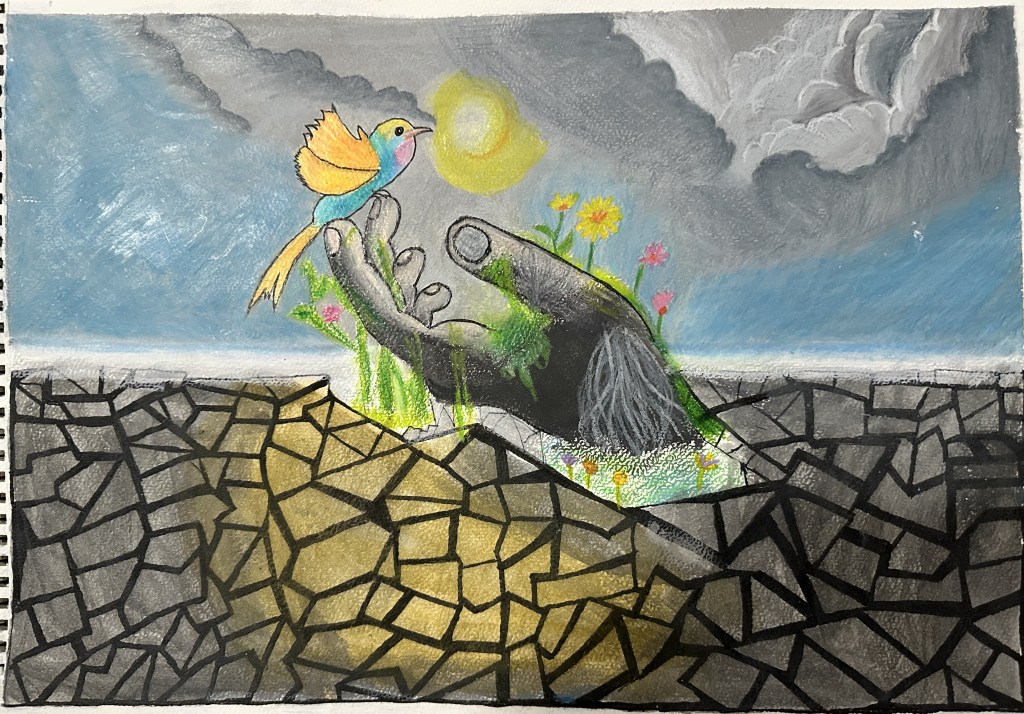
But behind the shiny facade was one problem technology could not solve: the water shortage.
Each family received a fixed number of litres of water per day. Every drop used for cooking, cleaning and drinking was counted by digital meters. Children learnt how to save water even before they learnt their multiplication tables. Long baths, green lawns and fountains were things of the past.
Anaya had never seen a river flow, splashed in puddles when it rained or watched drops run down a window. She had only heard about these things in stories.
One day, while she was helping her grandma clean the old storage room, Anaya found a wooden chest under a blanket of dust. Curious, she opened it. Inside there were stacks of photos, diaries, maps and newspaper cuttings. Nothing looked special until one picture caught her eye.
It depicted a group of laughing and dancing children under a stormy and cloudy sky. All of them were wet to the bone, their hair sticking to their faces and large puddles around them.
“What are they doing?” Anaya asked. Her grandma looked at the photo and smiled. “They are playing in the rain,” she replied.
Anaya frowned. “People used to play in the rain?”
Her grandma chuckled gently. “Yes, of course. Rain wasn’t such a rare thing when I was young. As soon as clouds appeared we would rush outside.”
That day, Anaya couldn’t get the picture out of her head. She sat at her window and started reading the diaries she had found in the chest. There she found descriptions of lush forests with bird song, constant rivers and communities collecting rainwater during stormy seasons. They also told an ugly truth about pollution, deforestation, overuse and climate change.
Over time rising temperatures and destruction of the environment changed the weather around the world. While in some places, there was drought; in others, there was flooding. The places that had not protected nature suffered the most.
Anaya put the journal away and looked out of the window at the city. She imagined how different things would be if people had made the right decisions years ago.
A few days later, her school announced that it would take part in an international competition called “The Future We Want.” Students had to come up with projects that could bring sustainable development and justice to the world. The winners would get their inventions presented to the world community, including world leaders, scientists, and youth organizations.
Everyone was excited about the news.
Some students planned advanced desalination systems. Others planned robots that could restore the environment. Most of them wanted to build bigger and stronger machines.
Anaya listened attentively to all their ideas, but still her mind returned to the old journals.
Maybe the future wasn’t only about inventing new things.
That day, she began sketching what she called the Rain Collector Network, a blend of old-fashioned rainwater harvesting and modern technology. Collectors on rooftops would store collected rain in underground tanks. Artificial intelligence would monitor water quality, manage supplies and predict future needs. Indigenous trees and plants would grow around the points of collection to add diversity and cool down the city.
But when Anaya showed her project to her class, the reactions were mixed. Some students were impressed; others found it hard to believe. “Rain hardly falls these days,” said one student. “Even if it rains once, will it really do any good?” Another student asked.
At first, Anaya felt disheartened. But each time someone questioned her idea, she became even more determined to prove that it could work.
Over the next several months, Anaya devoted herself to research. She read about environmental science in libraries and interviewed engineers, meteorologists and water conservation experts. Above all, she learned from her grandmother about the traditional ways past generations had saved water.
As her project developed, she discovered that communities all over the world had harvested rainwater for hundreds of years, and that these systems had kept people supplied during droughts. Modern technology could make them even more efficient.
Convinced by her research, Anaya approached the city council with her proposal.
To her astonishment, the council agreed and started a pilot programme in one neighbourhood.
It was not long before the whole community heard about it. Volunteers joined the project. Engineers shared their knowledge. Schools launched environmental campaigns. Rooftops were offered for tests.
What had started as a school contest became a community project.
The kids made murals of rivers, forests, and clean towns. There were workshops on saving water. It was one of those rare times when everyone worked towards a common goal.
Months of no rain passed. One day, black clouds appeared on the horizon. People stopped to watch. Slowly, the clouds spread across the sky and covered the bright desert sun.
The children waved. The adults looked at each other in hope. And then the first drop fell. Then a second. Soon, a light rain was falling all over the city.
The people went out of their homes to welcome the rain. Some of them laughed while some stood motionless to feel the rain on their skin. The elderly wiped tears from their eyes, remembering the old days. The rain lasted less than half an hour, but the Rain Collector Network caught thousands of litres of water.
For days afterwards, news channels reported on the project’s success. Scientists praised the way it combined traditional wisdom with new technology, and other communities asked to use the system too.
Over the next few years, rain collectors became a common sight in Al Noor. Water shortages became far less severe. Small forests grew across the city, giving birds and insects places to shelter, and some districts even became cooler because of all the plants.
People realized that sustainability was not someone else’s job. Everyone had a part to play.
Ten years later, Anaya had become a respected environmental engineer who worked all over the world, helping communities find their own solutions. Everywhere she went, she said the same thing: innovation should go hand in hand with love for nature and the wisdom of the past.
One day, Anaya was invited to speak at an international summit on sustainable development, attended by representatives of many countries.
After her speech, a young journalist came up to her. “What inspired you to create the Rain Collector Network?”
“A wooden box,” Anaya answered, smiling. The journalist looked confused.
She told him how a few old photos and journals had shown her the ancient link between people and nature. “Those memories taught me that the future isn’t only about progress,” she said. “Sometimes we have to rediscover the value of old ideas.”
That evening, as she left the conference hall, she saw clouds in the sky.
The light rain started falling.
Nearby, children rushed out into the square, splashing and laughing. Their happiness looked exactly like the happiness in the picture she had found all those years ago.
For a moment, it seemed that the past and the future had met. As Anaya watched the children, she knew the rain was no longer a miracle. It was a sign of hope, responsibility and cooperation.
As raindrops sparkled under the city lights, Anaya understood one thing for sure: the future is not something people inherit.
It is something they create through their decisions.
Aditi Haribabu is a student from Sharjah, United Arab Emirates. Currently studying at Delhi Private School, Sharjah, she is passionate about sustainability, storytelling and technology. In her free time, she enjoys writing, reading and art. Her favourite subjects are Mathematics and English, and she is especially proud of publishing a book and story in VOFG 2026, EcoGen Head, Silver Scholar in ASSET Talent Search and Rising Scholars Award in Junior Scholars Essay Contest 2026.

