By Maira Towsif Shaikh, UAE
On a warm summer afternoon, as Noura walked along the nearby beach, the wind carried a plastic bag high into the sky. As Noura looked around, she sighed. “Someone has to do something for nature,” she whispered. Noura is an 11-year-old girl from the UAE who is courageous and determined to help nature grow. She learned about the ecosystem from her school, and she always inspires everyone in her community to keep nature clean. Every day she visited the beautiful beach nearby. It was one of her favorite places. The soothing sound of the waves crashing against the shore, gentle swaying of the trees, tiny crabs and turtles racing across the golden sand created a magical and peaceful environment, but now, the beach was beginning to change. The bright and beautiful colors of nature were slowly fading away, replaced by dull and gloomy shades of grey, black, brown, and yellow. What was once a beautiful sandy beach with crystal-clear water was now covered with litter. Plastic bottles, food wrappers, and empty cans were scattered across the shore, ruining its natural beauty.
While walking along the shore something caught her eye which made her heart drop. It was a small sea turtle, struggling to move because a plastic bag was wrapped around its flippers. Without hesitation Noura rushed over and gently removed the plastic bag from the turtle’s flippers, and as soon as it was free the turtle quickly made its way back to the sea.
As she watched the turtle disappear into the waves, Noura felt a mixture of relief and sadness. She was happy that she had been able to help one animal, but she knew that many others were not as fortunate. Looking around, she noticed birds pecking near piles of rubbish and tiny crabs trying to crawl around pieces of plastic. The beach that once felt full of life now seemed to be silently asking for help. Noura realized that if people continued to ignore the problem, more animals would suffer every day.
A few steps further, she saw that people had made bonfires and left the coal in the sand, and sharp glass bottles lay in the water.
After this incident, Noura headed home and kept thinking of ways to save nature. The next day she went to her friends and discussed the incident with them. “What happened to the turtle is not just one accident,” Noura continued, “It is happening to thousands of animals around the world every single day. Plastic pollution in oceans is harming sea turtles, fish, dolphins, seabirds, and many other creatures. Animals often mistake plastic for food, which can make them sick or even kill them. Others become trapped in waste and cannot escape.”
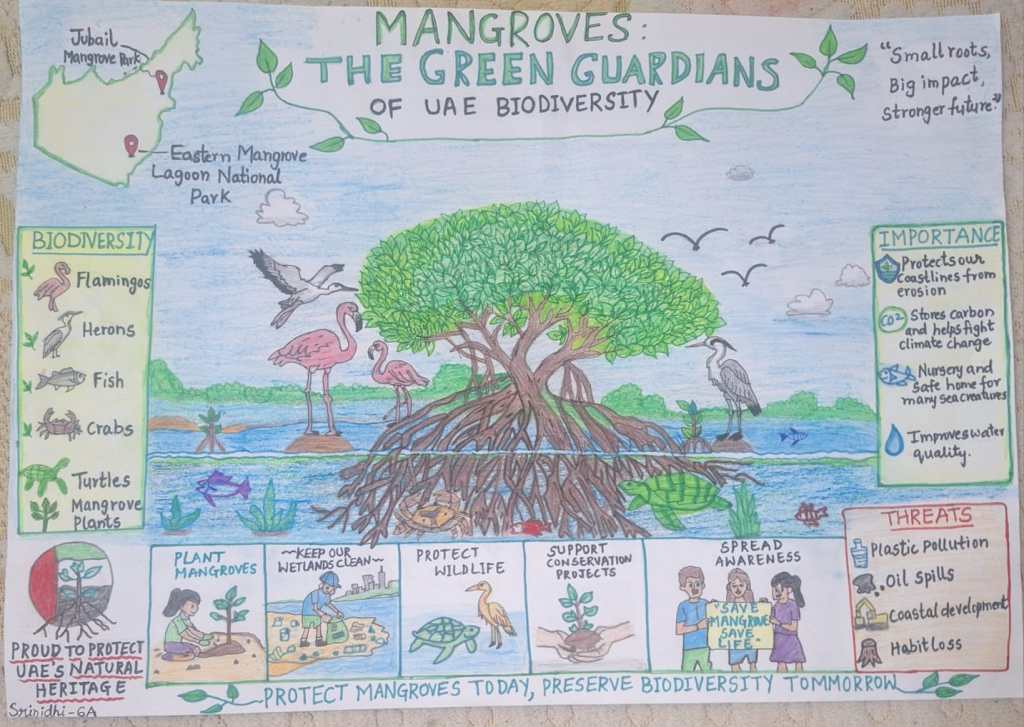
As Noura continued, she discovered that pollution was not only affecting animals. It was destroying their entire habitat. Coral reefs, which provide homes for thousands of marine species, were being damaged by pollution and climate change. Mangrove forests, which protect coastlines and support wildlife, were under threat. If people continued polluting the environment, future generations might never see many of these amazing creatures.
Noura went home and started researching deeper on how pollution affects nature. The more she learned, the more she understood the importance of SDG 12 (Responsible Consumption and Production), SDG 14 (Life Below Water), and SDG 15 (Life on Land).
Her research left her thinking about the sea turtle she had rescued, and wondering how many other creatures were suffering because of careless human actions.
As she continued reading, she discovered more about the UAE’s unique wildlife. Hawksbill sea turtles swam through the warm waters of the Arabian Gulf, Dugongs lived peacefully in seagrass meadows. Flamingos gathered in wetlands, painting the landscape in beautiful shades of pink. She learned about UAE’s protected areas such as the Ras Al Khor Wildlife Sanctuary, Mangrove National Park, Al Wathab Wetland Reserve and many more such areas that have pledged to protect nature and wildlife.
She was inspired to learn that Sheikh Zayed, the UAE’s founding father, had helped save the Arabian oryx from extinction, and that the country now protects large areas of mangrove forest.
That night, Noura sat by her bedroom window and looked up at the stars.
She imagined two different futures. In the first, beaches were covered with waste and the ocean was filled with plastic. Coral reefs had disappeared, and many animals had become extinct. Children could only learn about sea turtles and dugongs from photographs and books. In the second, the UAE thrived, with clean, golden beaches. The Arabian Gulf sparkling beneath the sunlight. Mangrove forests stretched across the coastline. Sea turtles nested on protected shores. Dolphins leaped through clear waters, and flamingos continued to gather in peaceful wetlands.
Noura knew which future she wanted.
She realized her fight was not just about saving animals, but about protecting the whole ecosystem. At that very moment, she promised herself she would do everything she could, no matter how small, and inspire her friends to do the same.
The next day Noura left her house with her bag and with determination. At first, only a few children joined her. Some people thought that one small cleanup campaign would not make much difference. However, Noura refused to give up. She visited schools, spoke to neighbors, and shared posters explaining why protecting nature was important. Her enthusiasm inspired others, and slowly more children, parents, and teachers became interested in helping. What started as a small idea soon grew into a community effort.
After joining several cleanup drives, Noura started her own campaign, called “The Future We Want,” especially for children aged 9 and 10, with hands-on activities that showed them how to protect the future. They went to different beaches and parks to help the environment heal.
As the weeks passed, more and more children joined Noura’s cleanup drive. Together, they collected waste, learned about protecting wildlife, and shared their knowledge with others.
Months later, the impact of Noura’s campaign could be seen across the community. Beaches looked cleaner, parks were filled with healthy plants, and more people began carrying reusable water bottles and bags. Teachers invited Noura to share her experiences with younger students, and local organizations praised the efforts of the children. Although there was still more work to be done, Noura felt hopeful because she knew that awareness was growing and people were beginning to care more about protecting the environment.
People in the community became more aware of their actions. Noura realized that even one person can make a difference when they inspire others to help. Her journey taught everyone that protecting nature is not only the job of governments and organizations; it is the responsibility of every one of us. From that day forward, Noura continued to be the Green Guardian of her society, proving that small actions today can create a cleaner, greener, and brighter future for generations to come.
Maira Towsif Shaikh is a student at Delhi Private School, Sharjah, UAE. A passionate young writer, she has published two books through BriBooks and enjoys creative writing, public speaking, and environmental activities. She also loves badminton, swimming, and crocheting. Through her stories and community initiatives, Maira hopes to inspire others and make a positive difference in the world.

