By Muntai Namusunga, Zambia
The sun over the village in Chongwe was not just hot. It was angry. For three years it burned the sky and forgot how to cry. The maize fields cracked open like broken hearts. The river became a memory of water.
Muntai Namusunga was 11 years old. But some mornings she felt much older, because hunger makes you grow up fast.
Her little brother, Nasalifya, was 8. Every night he would curl up next to her and whisper, “Muntai, will we eat tomorrow?” She would pull the thin blanket over him and lie. “Yes, my brother. Tomorrow the rain will come.” But deep inside, she was scared. She was scared the rain had forgotten them.
One day her teacher, Mr. Nyondo, wrote three letters on the chalkboard: SDG.
“Children,” he said, his voice soft but strong, “the United Nations made these Sustainable Development Goals for a better tomorrow. Today we learn about three promises for the world: SDG 2 – Zero Hunger. SDG 6 – Clean Water. SDG 13 – Climate Action.”
SDG. It sounded big. Too big for a girl with dusty feet. But that night, Nasalifya’s crying was louder than any big word.
After school Muntai ran to Gogo Christabel, her grandmother. She was 72, but her eyes were younger than Muntai’s. Her back was bent from working the land, but her spirit was straight like a tree. She was cooking cassava leaves, but there was no oil, no relish. Only hope in the pot.
“Gogo Christabel,” Muntai asked, holding her wrinkled hand, “why is the sky silent? Why did the rain leave us?”
Gogo Christabel looked at her for a long time. Then she said, “My child, the rain did not leave. We forgot how to call it home. My grandmother taught me that the soil is alive. It breathes. It remembers kindness. But we became impatient. We cut the trees. We burned the fields. We shouted at the land instead of listening to it. Now the sky is confused, and the earth is tired.”
Her words entered Muntai’s heart like rain on dry soil.
That night Muntai could not sleep. SDG 13 – Climate Action. The world said “climate change” was for presidents and scientists. But Nasalifya’s empty stomach was also climate change. And she was only 11. What could she do?
The next day, Mr. Nyondo brought a small tablet to class. On it, she saw farmers in Senegal digging tiny holes called “basins.” They covered the ground with grass so the sun could not steal the water. She saw children in Kenya collecting rain from their roofs into big drums. Every drop was treasure.
And then it happened. A fire started in Muntai’s chest. If Gogo Christabel knew the wisdom of the ancestors, and the tablet knew the wisdom of the world, what if an 11-year-old girl put them together?
She started a club. Just her at first. Then Chanda joined. Then two more girls. They were small, but their dream was big. They named themselves “The Rain Planters.”
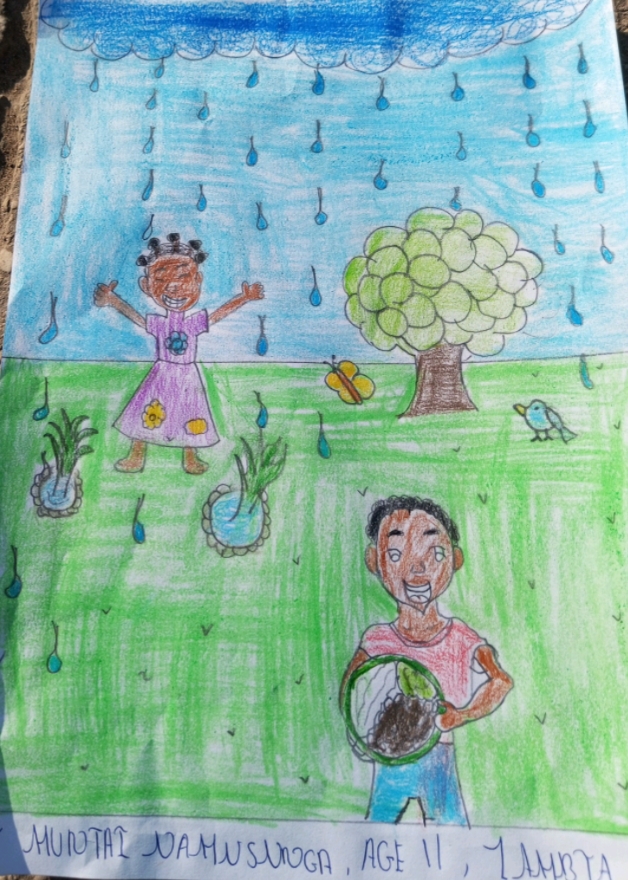
After school, they went to Gogo Christabel’s field with their hoes. Their hands got blisters. Their dresses got dirty. People laughed. “Look at Muntai and her friends. They think they can plant rain!”
But they dug anyway. Hole after hole. Basin after basin. One hand deep, in straight lines. They filled them with compost made from cow dung and dry leaves, Gogo Christabel’s wisdom. Then they covered the soil with grass mulch so the cruel sun could not drink the water first, the tablet’s wisdom.
They also knocked on doors. “Aunty, please put a bucket under your roof. Uncle, save the rain in that old drum.” “Every drop counts,” they said.
Weeks passed. The sky stayed silent. Nasalifya grew thinner. His eyes looked bigger in his small face. Chanda wanted to quit. “Muntai, they are laughing at us,” she cried.
Muntai held her hand and remembered Gogo Christabel’s words. “Chanda, wait. Seeds do not shout when they grow. They just grow in silence. We must believe before we see.”
And then the clouds came. Soft at first, like whispers. Then heavy, like promises. Rain fell. Not a flood. Not a miracle. Just enough.
The water did not run away. It fell into their basins and stayed. The mulch hugged the soil. And in Gogo Christabel’s field, where there was only dust, green shoots pushed up. Small, brave, green shoots. Like hope.
Women came running. “Muntai! How did you teach the land to drink?”
Muntai stood in the mud with her dirty dress and her full heart and said, “I didn’t teach the land. I listened to it. Gogo Christabel taught me respect. Mr. Nyondo taught me science. SDG 13 means we don’t wait for tomorrow. We act today.”
By the next season, 20 families were digging basins. Their school started a garden. They planted rape greens, beans, and tomatoes. And for the first time in three years, Nasalifya, her 8-year-old brother, walked to school with food in his stomach and a smile on his face. SDG 2 – Zero Hunger was no longer just letters on a board. It was real. It was in his bowl.
Muntai was still 11 years old. She was still small. Her voice was still soft. But she learned the most powerful truth: You do not have to be big to make a big change. You do not have to be a president to heal the climate. You do not have to be rich to fight hunger.
You just have to plant something.
Plant a seed. Plant an idea. Plant a basin in dry soil. Plant hope in a tired heart.
Last month, a man came from Lusaka with a camera. He said their story would go into a book called “Futures.” A book that children all over the world will read. He knelt down to Muntai’s level and asked, “Muntai Namusunga, what is your message for the world?”
She looked at Gogo Christabel’s green field. She looked at Nasalifya, 8 years old, running and laughing with a full stomach. She looked at her friends, their hands still dirty, their eyes full of light.
And she said, “My message is this: The future is not something that happens to us while we wait. The future is something we plant with our own hands. One basin at a time. One child at a time. One act of courage at a time. For a fair, clean, and sustainable tomorrow.”
The rains had been late. But the children had not waited.
They were the Rain Planters.
And they were growing.
THE END
Muntai Namusunga is a Grade 6 pupil at Kings Highway SDA School in Lusaka, Zambia. She is passionate about environmental conservation, sustainable tourism, child advocacy, and modelling. She enjoys sightseeing, making new friends, and promoting Zambia’s cultural heritage. Her favourite subjects are English, Mathematics, Science, and Social Studies. She is also interested in the United Nations Sustainable Development Goals, particularly SDG 2 (Zero Hunger), SDG 6 (Clean Water and Sanitation), and SDG 13 (Climate Action). Inspired by her mother, an academician, Muntai hopes to use her voice and talents to advocate for children, protect the environment, and make a positive difference in her community and beyond.

