By Ana Amarazeanu, Romania
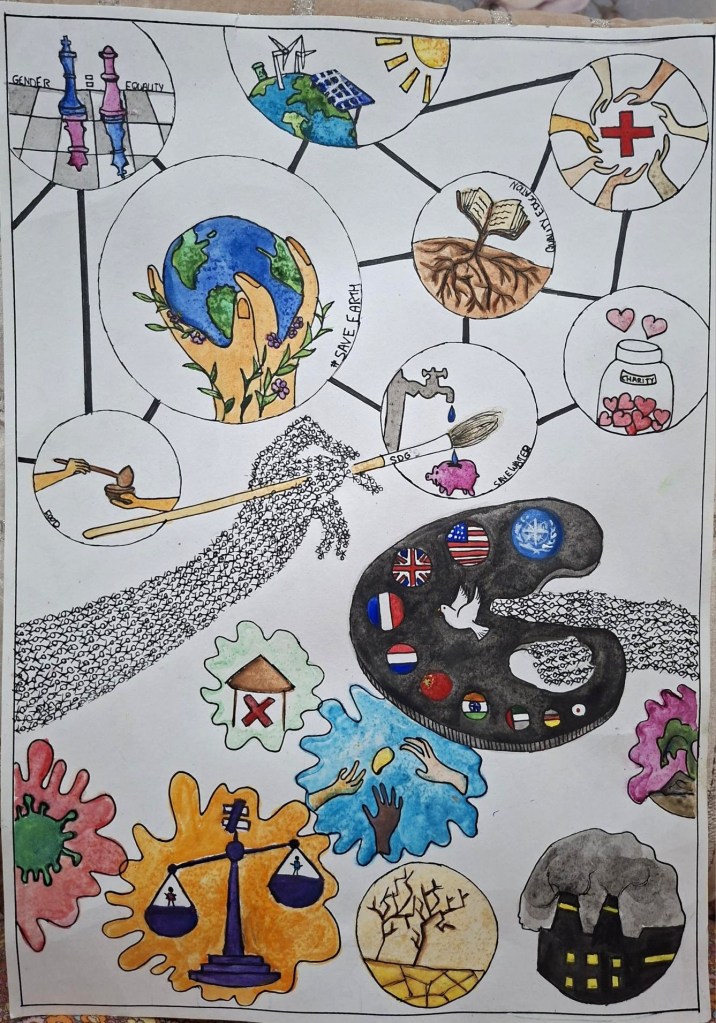
Every day, when I turn on the lights or charge my phone, I rarely stop to think about what a privilege this is. Yet around 730 million people around the world still live without electricity, and millions more depend on polluting fuels like coal or wood. Around 80% of the world’s energy still comes from fossil fuels, even as we face the urgent reality of climate change. Energy is the heartbeat of modern life, and without it, opportunities for education, health and progress are dimmed. That is why Sustainable Development Goal 7, Affordable and Clean Energy, feels so urgent to me.
I remember visiting my grandparents’ village in Romania, where power cuts were frequent in winter. The whole street would fall silent, broken only by the crackling of wood being tossed into stoves. Inside their house, the air grew heavy with smoke, and the rooms were lit only by the trembling glow of a candle. I wondered how different life would be if every home had its own solar panel or small wind turbine, just enough to keep the lights on, the stove running and the air clean. For families like theirs, energy is not just a bill to pay each month; it is the line between comfort and hardship.
These memories remind me that the global energy crisis is not abstract. It is lived in homes, villages and schools on every continent. In Europe, we often talk about wind farms in the North Sea or solar parks in Spain, but I think of smaller, local solutions too. What if every school became partly energy-independent, powered by rooftop solar panels shared with the surrounding community? Students would learn about sustainability first-hand, parents would see lower bills, and the transition to clean energy would feel personal, not distant.
For my generation, the question is not whether we can switch to clean energy, but how quickly we can make it real in the places we love most. If we imagine energy as a shared resource, built by communities, sustained by innovation and valued by people, we can create a future that is fairer, healthier and brighter.
Ana Amarazeanu is a student from Râmnicu Vâlcea, Romania. Currently studying politics, psychology, and mathematics, on a pre-law track at New York University, she is driven by a belief that fairness should be built into the systems we live in, and by a curiosity about how laws shape daily lives and help create a better society. In her free time, she enjoys reading, debating, skiing, sports, playing the piano, and more. Her favourite subjects are the ones she currently studies at NYU, and she is especially proud of having built a new life abroad, moving from Romania to New York to pursue her studies and reaching for any opportunities in order to achieve her goal of going to law school.

